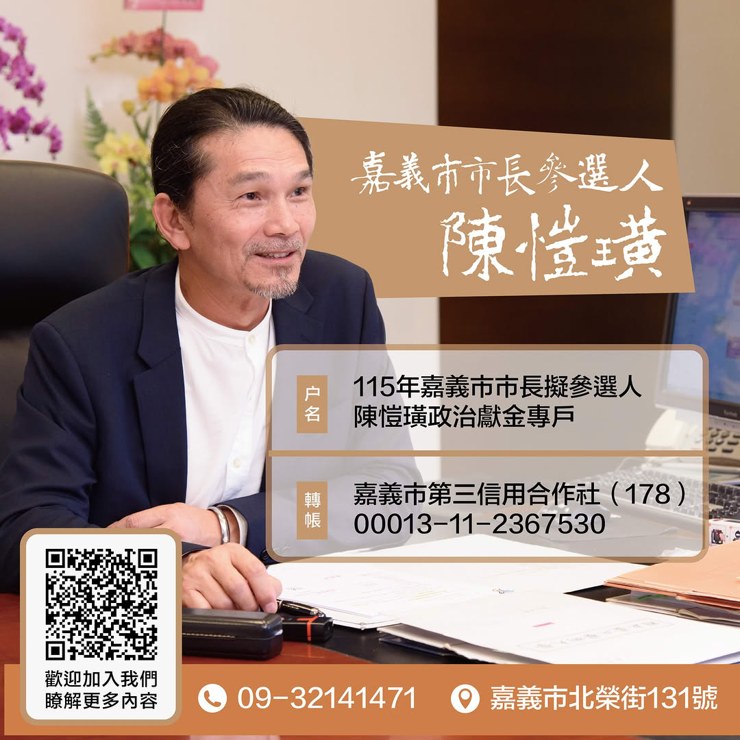
Chen Kai-Huang · Officially Registered for Chiayi City Mayor
Chiayi City Election Commission — standing up for our city with unwavering conviction
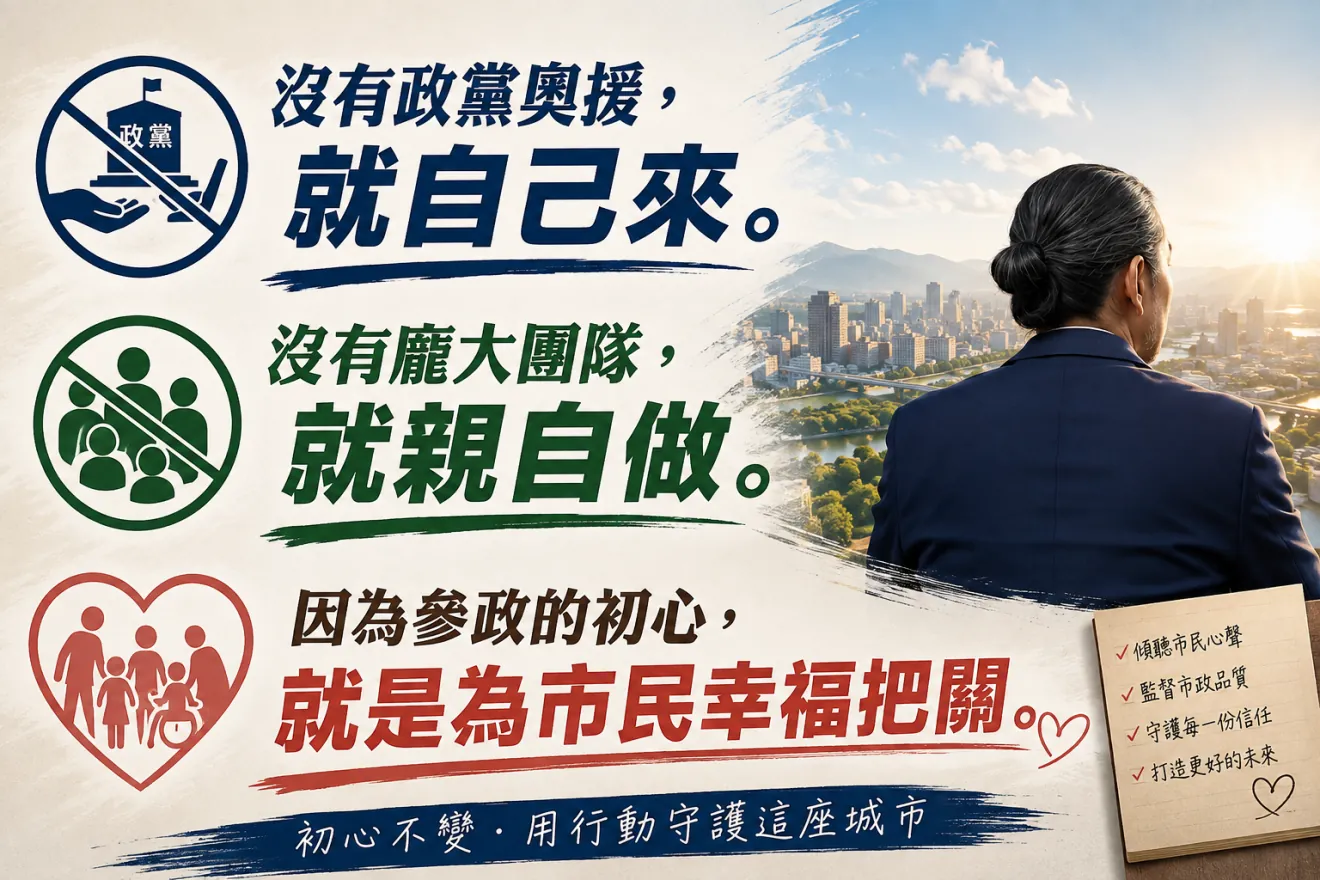
No party backing — we do it ourselvesNo large team — we do it personallyBecause the heart of public service is safeguarding citizens' happiness
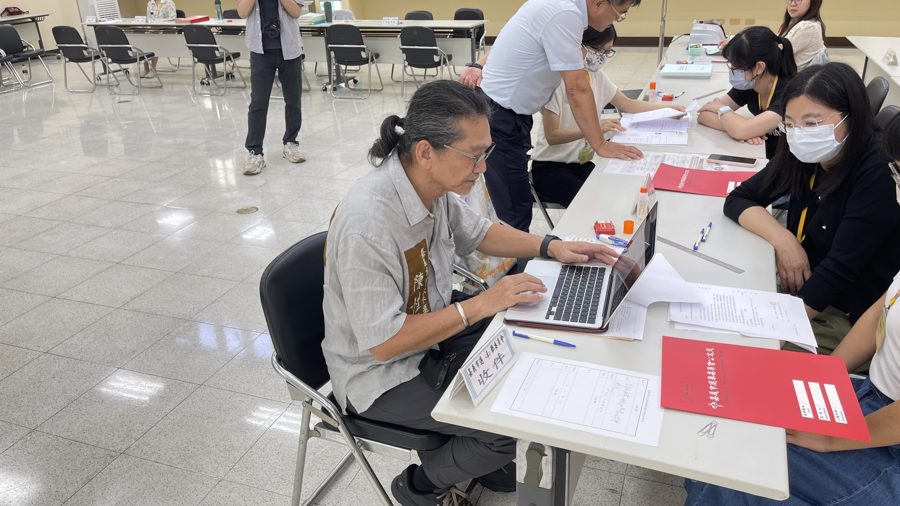
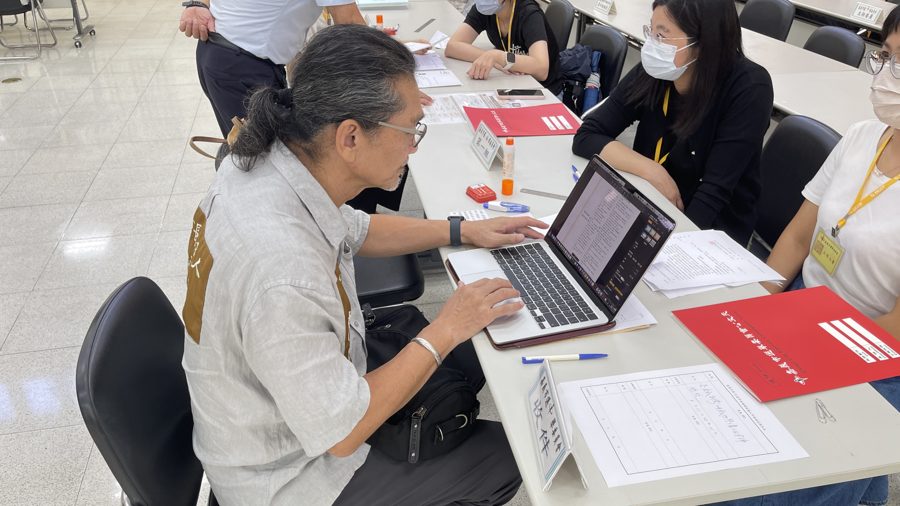
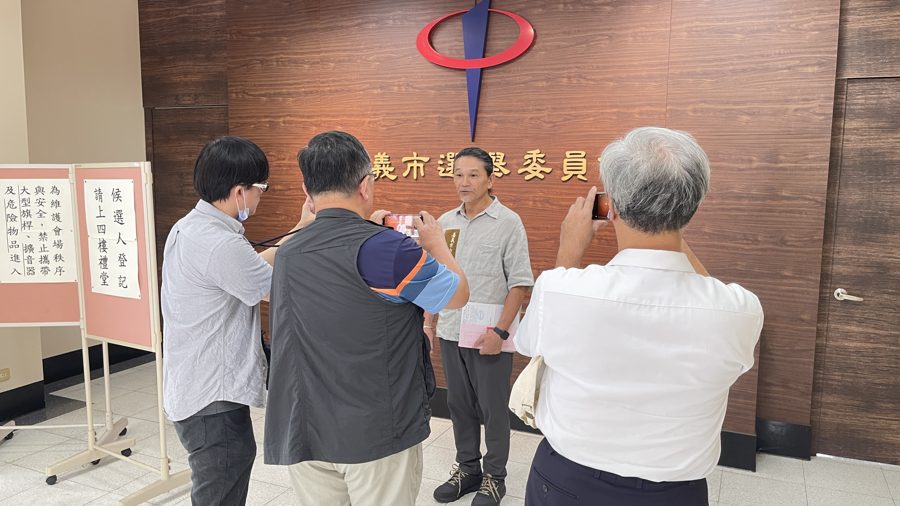
Chiayi City Election Commission · Registration Chen personally fills out the candidacy formChiayi City Election Commission · Candidacy form Items corrected on site by the candidateChiayi City Election Commission Press interview after registration
Reviving Chiayi's Economy with an Urban Digital Twin
A digital twin builds a real-time replica of the city of Chiayi in the digital world —
letting every street, every park, and every bit of foot traffic and opportunity be
seen, simulated, and optimized.
Principal Chen Kai-Huang proposes turning this smart-city data engine into
ten economic drivers —
from the Walkable Economy to wood-culture creativity, from faith tourism to mobility economics —
so the ancient city of Chiayi may once again flourish and shine.
Profile · Kai-Huang Chen
Education & Experience
From a kindergarten in Chiayi to the Beaux-Arts in Paris, and on to the presidency of TNUA — the complete record
Education
Degrees & Training
12 items
2026-PhD programme, Department of Civil Engineering, Tamkang University (architecture division)
2018ISO-14064-1 Internal Verifier Training Course Achievement
1999Post-master's programme in Internet and Digital Multimedia Design, College of Commerce, National Chengchi University
1988École nationale supérieure d'architecture de Paris (founded 1669) — studies in architectural elements
1986-1990École nationale supérieure des Beaux-Arts de Paris (founded 1648) · Diplôme National Supérieur d'Arts Plastiques, D.N.S.A.P. (master's level), awarded with the jury's unanimous commendation (first prize)
1984First sculpture and spatial installation workshop, Council for Cultural Affairs
1983-1986National Taiwan Academy of Arts, Department of Fine Arts, Western Painting Division (founded 1955; Distinguished Alumnus of National Taiwan University of Arts, 2018)
1979-1982Marine Corps, 307th class (77th Division) — radio communications NCO, Marine Corps NCO School
1975-1978Provincial Chiayi Senior High School (founded 1924; Distinguished Alumnus 2018)
1973-1975Chiayi County Lantan Junior High School (founded 1961; Distinguished Alumnus 2022)
1966-1972Chiayi City Minzu Elementary School (founded 1919; Distinguished Alumnus 2020)
1965-1966Chiayi City Wufeng Kindergarten (founded 1915)
Experience
Posts & Appointments
33 items
2026-2028President, Taiwan Teacher Professional Development Association (7th term)
2025-International juror, Art Venture Ehime Fes 2025 (Ehime Art Triennale, Japan)
2024Selection committee, Taiwan national pavilion at Expo 2025 Osaka (Ministry of Economic Affairs / TAITRA)
2024-2025Initiator, Shared Campus on Taiwan (Scot) — inter-university programme of cross-disciplinary campus sharing (TNUA, University of Taipei, NIU, NCNU)
2023-Founding board member, Taiwan Rural Children's Education Foundation
2022-Executive and selection committee, public art for New Taipei youth social housing, and for the MRT Wanda Line (Taipei Metro)
2019-2024Founding Director, Graduate Institute of Trans-disciplinary Creative Writing, College of Humanities, TNUA
2019-2025Founding board member and Chairman, Taipei Guandu Culture and Arts Foundation
2019-2025Board and committee member, Institute of Engineering Education Taiwan (IEET)
2019-2025Selection committee, Arts Education Contribution Award, Ministry of Education
2017-2025President, Taipei National University of the Arts (TNUA)
2017-2025Chair of the board (2017-2023) and Vice-Chair (2023-2025), Asian League of Institutes of the Arts (ALIA)
2017-2025Initiating and partner institution, ELIA / Shared Campus — international programme in higher arts education
2017-2025Member, Arts Education Promotion Committee, Ministry of Education (convener and deputy convener of its legal affairs group)
2017-2025Board member, Taipei Culture Foundation
2017-2025Cultural affairs adviser, Taipei City Government
2015-2025Member, public art review committees of New Taipei City, Taoyuan City and Yilan County
2007-2023International (external) examiner of master's theses, Chinese University of Hong Kong and Education University of Hong Kong
1996-2025Full professor, Graduate Institute of Trans-disciplinary Arts, School of Fine Arts, TNUA (Department of Fine Arts / MFA and PhD programmes; founding director of the institute) — retired 2025
1996-Founder, Laboratory of Art and Concept (Lab. TCHENOGRAMME, non-profit)
Arts-related positions
2016-17Board member, Tamsui Culture Foundation
2015-16Chief consultant, public art project for the MRT Sanying Line — Kung Sing Engineering, Bombardier (Canada), Mott MacDonald (UK)
2014Distinguished Professor, TNUA
2013-16Board member and Chairman, Sanzhi Culture Foundation
2013-16Dean, School of Fine Arts, TNUA
2006-Executive and selection committee member for more than fifty environmental and public art projects
2006-10Chairman, Department of Fine Arts and Graduate Institute of Fine Arts; Director, Graduate Institute of Plastic Arts; founding Director, Graduate Institute of Trans-disciplinary Arts, TNUA
2005Dean of Student Affairs, TNUA
2000CEO, Communiversity E-learning
1999Founded "THE SCHOOL / L'ÉCOLE"
1998Internet art consultant, Dreamer's media
1996Art director, Baleine Design Studio
1995Editor-in-chief / artistic director, ETAT (在地實驗) — founded its online TV station (etat web tv site)
10 Economic Policies
Ten Economic Policies
One urban digital-twin engine · Ten economic growth pillars
I
Walkable Economy
Build pedestrian-friendly districts and walkways, making foot traffic the steadiest artery of the local economy — shops, vendors, and neighborhood life thriving together.
Read the full details ▸
II
Interfaith Economics
Connect Chiayi's diverse religious sites to develop pilgrimage tourism and festival economies, turning sacred heritage into a city brand.
Read the full details ▸
III
Park Economics
Revitalize parks and green space with markets, arts, and leisure spending — making green space not just a place to rest, but the living room of the local economy.
Read the full details ▸
IV
Wood-Capital Economics
Polish Chiayi's "Wood Capital" heritage: woodcraft, recycled timber, and artisan supply chains — letting an old tune find a new voice.
Read the full details ▸
V
"Tsu-lo Development" Economics
Market the old city through film and storytelling — developing screen, photography, and creative-tourism economies so local history is seen by the world.
Read the full details ▸
VI
"Art Dream Center" Economics
Build artist clusters and dream-incubation hubs, letting creativity drive commerce as artists and the city prosper together.
Read the full details ▸
VII
"Cross Corridor" Economics
Link the old town's cross-axis to revive commercial corridors and street economies, drawing people and spending back to the historic core.
Read the full details ▸
VIII
Ultra-Low-Floor Transit Economics
Introduce low-floor public vehicles and tourism shuttles for barrier-free, stroll-friendly mobility — making every journey create value.
Read the full details ▸
IX
Waste-as-Resource Economics
Turn waste into resources: a circular economy and environmental industries that transform municipal waste from a burden into a growth driver.
Read the full details ▸
X
Urban Digital Twin Economics
Build a digital twin of the city, driving governance and industry innovation with data — moving Chiayi toward a future of both intelligence and prosperity.
Read the full details ▸
1. Introduction: From Urban Mobility to a Local Economy
In contemporary urban development and tourism planning, the choice of transport often decides how deeply people perceive a city. Chiayi's distinctive "Walkable Economy" rests on a simple proposition: by slowing the pace of movement, old downtown districts come back to life, and residents and visitors alike create real economic value as they stroll — turning local culture into sustainable economic output.
2. The Speed Paradox and "Friction Economics"
We are used to chasing speed and convenience. Driving or riding gets us to our destination quickly, yet high-speed movement mostly produces noise and exhaust. Here lies a key urban economic paradox — the faster a city moves, the poorer it becomes; the slower it moves, the stronger its economic stickiness.
Key Concept
Friction Economics Walking is a mode of movement with a high degree of "friction". The higher the friction coefficient — the more often visitors stop to look, listen, smell, buy and eat — the greater the commercial activity and economic output it generates. Conversely, the expressways and fast-moving zones that ring a city stay commercially barren precisely because there is nowhere to stop.
When the speed of movement drops from car to scooter, to bicycle, to walking (about 4–5 km/h), visitors finally open all five senses. They can smell the flavours of the 1960s, see the carefully arranged displays of small alley shops, and pause to spend. This lingering is exactly how the micro-circulation of the street works.
3. Chiayi's Natural Advantage: the Golden Walking Circle of "Da-tong" and "Er-tong"
Chiayi has exceptional natural conditions for the Walkable Economy. Cities recognised internationally as walkable have core districts of roughly 5 to 8 square kilometres — and Chiayi's city centre matches that scale perfectly:
Da-tong: Zhongshan Road, the main artery running out from Chiayi Station.
Er-tong: Zhongzheng Road, the historic core where old firms and commerce have clustered for a century.
The old core district woven together by Da-tong and Er-tong is the "yolk of the yolk" of Chiayi. Walking from one end to the other takes 15 to 30 minutes; by scooter, under 10. This compact, history-rich scale means visitors need no complicated public transport — their own two feet are enough to experience Chiayi's distinctive "sense of living".
4. Living Sensors: How Walkers Spread the City
In the Walkable Economy, walkers are not only the main creators of friction; they are also an indispensable "living sensor" in city marketing.
When walkers open all five senses and experience local history, stories and daily life, those memories are imprinted deeply and shared proactively through modern social media. This bottom-up word of mouth carries far more conviction than dry official advertising. Walkers are consumers — and the best transmission units a city has.
5. The Government's Role and the Road Ahead
What role should government and local governance play for such a promising Walkable Economy? Among them, the city government's most important task is to "dig the local stories out".
The Walkable Economy rests not on abstract economic theory but on an abundant, substantial source of cultural content. Only by unearthing and organising historical stories can the Walkable Economy be given an inexhaustible local soul — so that visitors not only stay and cannot leave, but truly immerse themselves in the most authentic "Chiayi Lifestyle".
Source: condensed from the "Walkable Economy" episode of the "Tsu-lo Economics" series.
1. Introduction: Chiayi's Distinctive Urban Fabric and Religious Atmosphere
As the second core theme of the city's economy, Interfaith Economics takes up the thread of the Walkable Economy. The two share a deep underlying logic — both take the "city" as their foundation and are rooted in a rich historical and cultural context.
Compared with metropolises such as Taipei — where modern life moves fast, people keep their distance from neighbours, and the religious boundaries between groups blur and are rarely discussed openly — Chiayi, a small historic city, presents a very different picture. Its streets and lanes are full of temples, churches and Catholic halls; the buildings and bases of different faiths stand side by side, touching, even interwoven. Whether it is Buddhism and Taoism with their many worshippers, Christian churches found everywhere, or the considerable number of Catholics who openly profess their faith, the air of this city always carries a special quality: religious distance is extremely close, and the atmosphere is dense.
Every religion, over the course of history, has developed its own highly independent and smoothly operating methods of mobilising social resources and organising itself. Yet from the perspective of city governance and macro development, the role of the city government should never be simply to let each religion "go its own way". How to make good use of these historically accumulated core religious values, ethical values and positive ideas — turning them into the city's cultural landscape and forming a distinctive "symbiosis and shared prosperity" with the city — is precisely the core meaning of Interfaith Economics.
2. Echoes of History: from the Renaissance to the story of Chiayi's great temples sheltering the small
To understand the feasibility of Interfaith Economics, the brilliant "Renaissance" of Western history is a classic example. The great works of masters such as da Vinci, Michelangelo and Raphael were almost all closely bound to religion. Yet today we no longer view these works as confined to religious dogma, but as humanity's great "cultural assets". It is precisely through artistic translation and annotation that later generations can deeply savour and look back on the religious development and humanist awakening of that era.
This symbiosis of religion, art and history is equally visible in Chiayi's own history — it is no flight of fancy. Local history, from the Japanese colonial era through the years after the Second World War, offers a vivid illustration:
Historical Memory
The local story of Chiayi Chenghuang Temple as "sub-landlord" In the late Japanese colonial period, Japan promoted the colonial "Kōminka movement" (imperial subjectivation) and at one point abandoned many local temples in Chiayi, banning religious activity. So that incense could continue and the deities would have a home, many small temples "took lodgings" inside larger ones — the historic Chiayi Chenghuang Temple, for instance, sheltered and kept the deities of many small temples. Only after the end of the Second World War, as local people regrouped and demanded it, were these small temples "taken back" one by one, with worshippers buying land and building temples of their own.
This process — a great temple acting as "sub-landlord", sheltering the small ones through a historical storm — created an exceptionally distinctive, mutual-aid, deeply human story within Chiayi's local religious network. The idea of Interfaith Economics is founded on precisely such deep historical feeling and local memory.
3. The City Government's Strategic Position: three levels of transformation
When outsiders ask, "Each religion already has its own way of operating — what can the city government actually do by stepping in?", the city government's strategic position must be clearly defined: it has no intention of replacing any religion. It plays the role of "integrator" and "platform promoter", using systematic policy guidance to let the major religions bring a greater force of social good into play. Concretely, this requires three key levels of transformation:
Aesthetic translation of religious ritual: shaping the city's public cultural landscape The first task is a deep "aesthetic translation" of the rituals, festivals and core spirit of each religious tradition. Repackaged through modern art and aesthetics, these traditional rites are no longer closed sectarian activities but can become the city's "public cultural landscape". Just as the great cities of continental Europe owe their soul and their tourist appeal almost entirely to their historic religious context, this adds rich religious and humanistic layers to Chiayi's own character.
A virtuous cycle of religious resources: breaking competition, sharing a platform The second level is to use a public resource platform provided by the city government to turn potentially competitive religious resources into a virtuous, cooperative mechanism. Drawing on the historical spirit of mutual aid — the great temple sheltering the small ones — a modern religious platform can foster dialogue and resource sharing among different denominations, so that religious groups no longer each go their own way but complement one another on one shared aesthetic map and historical axis.
From private consumption to a shared aesthetic economy: religious festivals all year round The third level is to elevate what people understand as "individual private consumption" into an entirely new "shared aesthetic economy" through this interfaith aesthetic mechanism. In future, Chiayi can break out of the framework of single-temple events and, following the model of music, art and culture festivals, regularly hold ambitious "Interfaith Arts Festivals" or "Religious Festivals".
Through year-round cyclical activity, different religious festivals and cultural seasons take turns, echoing one another. The city government plays the key integrating and promoting role, making them land successfully and thereby driving local cultural tourism and economic output.
4. Conclusion: elevating religious value into a sustainable symbiosis for the city
In sum, the Interfaith Economics proposed in "Tsu-lo Economics" is not superficial commercial manoeuvring but a profound movement of urban cultural revival. It deftly captures Chiayi's distinctive spatial character — "temples and churches everywhere, all close together" — and turns the local story of great and small temples living in mutual aid into nourishment.
Through the public platform built by the city government and three transformation mechanisms — aesthetic translation of ritual, a virtuous cycle of denominational resources, and the creation of a shared aesthetic economy — Chiayi can turn its accumulated positive religious values into a year-round, never-switching-off urban cultural festival. This not only gives religious groups and the city a distinctive cultural landscape of "symbiosis and shared prosperity"; it also opens, for a Chiayi modest in size, a path of sustainable development that combines humanistic depth with economic vitality.
Source: condensed from the "Interfaith Economics" episode of the "Tsu-lo Economics" series.
1. Beyond the Greenery Myth: rethinking parks and city scale
In the development of contemporary metropolitan areas, parks are often treated as an appendage to daily life. Most residents expect something quite basic — fresh phytoncide air, a playground for children, a place for elders to rest — and often reduce a park to statutory green space: "so long as there are plants and it counts outside the residential floor-area ratio". Yet seen from the macro perspective of urban development and economics, this uniform model of parks fails to realise its greatest potential in a city that is modest in scale and whose population has entered the super-aged stage.
Chiayi is a case in point: it holds as many as 52 designated parks and green spaces of varying kinds, and by ratio to registered population ranks among the highest in Taiwan. Against the double backdrop of its "Wood Capital" heritage and a super-aged society, leaving these 52 parks at the traditional level of recreation is undeniably an under-use of resources. How to break out of the conventional frame and turn these scattered green belts into a strategically meaningful "Park Economics" is a question of urban development worth deep thought.
2. Historical Context and Collective Memory: from "Wood Capital" to a living ecosystem
Since the Japanese colonial period, Chiayi has served as the gateway and distribution hub of the Alishan timber industry, bound for a century to the character "wood" and earning the name "Wood Capital". This historical destiny is not merely an industrial legacy of the past but a key asset for the city's transformation today.
The traditional idea of the Wood Capital focused on cut and processed timber structures and historic buildings; in modern Park Economics, however, the trees in a park are "living woods". This shift from "dead timber" to a "living ecosystem" tightly links historical culture with natural ecology. These 52 parks should not be isolated plots of green but collective memory sites that carry the long river of history, full of story and cultural depth. Through integrated green-belt planning, parks become important nodes of urban carbon sink, dovetailing perfectly with the global wave of ESG (environmental, social, governance) sustainable development.
3. Spatial Aesthetics and Urban Curation: building a school without walls
Drawing on the experience of international cities — Chicago, for instance, where rivers, green belts and large-scale public art (such as Cloud Gate) interweave to shape a cultural landscape and a tourist landmark amid the bustling downtown — Chiayi likewise has what it takes to shape a distinctive landscape.
When these 52 parks are given different themes and identities, they are no longer monotonous recreation spaces but 52 exhibition venues for the city. Combined with the area's rich educational resources — including more than ten colleges and universities in and around Chiayi covering agriculture, the environment and other professional fields — these parks can become grounds for hands-on talent development. Young students and professionals can practise environmental aesthetics, landscape design and ecological maintenance there, turning the whole city into a "school without walls". This not only creates an urban cultural landscape; it offers an excellent platform linking local education with practice.
4. A Sustainable Economy and a Future of Shared Prosperity
The core value of Park Economics lies in breaking the narrow assumption that "a park is just green space" and upgrading parks into a strategic engine for sustainable urban development. Concretely, its benefits cover four core dimensions:
Meeting residents' daily needs: balancing everyday recreation with the quality of health care in an ageing society.
Expressing historical and cultural texture: making parks a vehicle for telling local history and Wood Capital stories.
Boosting city marketing and residential appeal: attracting people from elsewhere to move in, and strengthening the brand of "the city best suited to retired life".
Driving tourism and green industry: using a distinctive green landscape to draw visitors to linger, and developing an extendable ESG-related green industrial chain.
5. Conclusion
In sum, Chiayi's 52 parks are by no means an accidental by-product of urban development but a necessary treasure carried on from the city's historical context. In an age when sustainable development has become a mainstream discipline, how well these existing spatial assets are used — fusing the Wood Capital's historical destiny, the ecological value of living plants, agricultural aesthetics and the cultivation of young talent — will be key to whether the city can open up entirely new possibilities amid the super-aged wave. Park Economics is not merely a movement to remake space; it is a profound practice concerning urban identity, environmental sustainability and economic transformation.
Source: condensed from the "Park Economics" episode of the "Tsu-lo Economics" series.
1. The City's Distinctive Context: the historical chance that preserved six thousand old wooden houses
Looking across the world's great cities, after modernisation, urban renewal, war and upheaval, the overwhelming majority of their historic wooden building clusters have long since vanished. Chiayi, however, has miraculously kept a stock of wooden houses — more than six thousand of them — reaching back from the Qing Empire period to the modern era.
Explanations for how these precious assets survived differ: one holds that Chiayi simply developed slowly enough to preserve them "by luck"; another credits the deep attachment and fierce guardianship of local residents. Whatever the historical accident, now that these six thousand old wooden houses actually stand in the city's streets and lanes, how to turn them from a "burden of historical heritage" into a "new driver of urban economics" has become the most central question of local governance today.
2. Bridging Time: re-examining historical assets against contemporary needs
Faced with this precious historic wooden settlement, we cannot remain at a nostalgic, purely historiographical viewpoint: it must be precisely matched to "contemporary global demand". Before the year 2000, the United Nations had already begun promoting sustainable-development indicators; and after the wave of globalisation in the 1980s, geopolitics and environmental change have forced humanity to look at old things with entirely new eyes.
The core of this alignment with contemporary sustainability indicators can be summed up in three aspects:
Breaking away from traditional administrative subsidies: the past model of annual, case-by-case subsidies — barely one hundred-odd houses every ten years — was far too slow; at that pace it would take some five hundred years to repair them all.
Bringing in ESG and carbon-credit thinking: treating the six thousand-odd old wooden houses as one complete ecosystem, and giving them the substantive function of a "carbon-fixing device".
Linking capital across borders: starting from Taiwan and extending to Asia and the wider world, attracting international actors who seek sustainable investment and carbon returns, so that renovating old houses gains large and practical support from private and international capital.
3. The Core Strengths of Wood-Capital Economics: green building, carbon banking and the aesthetics economy
Approached through carbon footprint and architectural theory, Wood-Capital Economics holds an absolute advantage in today's sustainability wave. New reinforced-concrete buildings generate large amounts of carbon emissions and construction waste, whereas Chiayi's old wooden houses are themselves a concrete embodiment of "carbon banking" — the carbon was fixed inside the timber long ago.
"We are only renewing, not building new." On a fair basis for calculating carbon, preserving and repairing old wooden houses not only avoids the environmental burden of cement and steel but meets the strict standards of green building perfectly. Combining historical depth with environmental benefit, this approach scores extremely highly in sustainability assessments.
4. Learning from Abroad: shaping an aesthetic experience like European castles and old Japanese streets
In terms of aesthetics and tourism value, Wood-Capital Economics opens up an enviable imaginative space:
The historical gaze of European castles: Europeans visit castles precisely for the historical depth accumulated over centuries of time. Chiayi has wooden architecture from different eras, from the Qing Empire to the Japanese colonial period, and equally possesses profound historical reach.
The immersive experience of Japanese guesthouses: travellers to Japan often prefer to stay in traditional wooden guesthouses of old-world charm; the atmosphere they create far surpasses that of ordinary modern hotels.
Chiayi absolutely has the potential to develop in this way — given the right opportunity, these six thousand-odd old wooden houses can meet the world anew under an ESG ecosystem concept that answers the needs of the present and even of the future.
5. Conclusion: a visible future of eight to fifteen years, and a vision in which everyone wins
Traditional allocation of public resources is often a mere drop in the bucket; but if the "Cultural Endowment" mechanism can be perfectly combined with the spirit of ESG, Wood-Capital Economics will be not merely win-win but a multi-win urban revolution.
With the injection of international capital and the construction of a contemporary ecosystem, these six thousand-odd city corners once facing decay will, within just eight, ten to fifteen years, be fully repaired and renewed at a visible pace. This not only earns international recognition for the name "Wood Capital"; it lets the historical thread show a brand-new continuity within a contemporary mission of sustainability, setting a model blueprint of economic transformation for Taiwan's mid-sized cities.
Source: condensed from the "Wood-Capital Economics" episode of the "Tsu-lo Economics" series.
1. Preface: finding the city's position within a century-spanning historical rift
Looking at the development of contemporary cities, most local governments, while pursuing modernisation, unconsciously fall into a uniform myth of concrete and asphalt. Yet the preciousness of an ancient city like Chiayi — the first ancient city of Taiwan, with more than three hundred and twenty years behind it — lies not in competing for skyscrapers but in the thickness of time layered beneath the ground. Under the title "Tsu-lo Development", this is not merely a recollection of history but a thoroughly forward-looking vision for urban aesthetics and economic regeneration.
The core value of "Tsu-lo Development" lies here: when the physical ancient city can no longer be fully restored — after repeated land readjustment, road building and privatisation — how can contemporary art, architecture, aesthetics and technology summon back the city's "spectre" and its historical soul? This is not only a project of cultural-asset revival but a tailor-made transformation of Chiayi towards an urban aesthetics economy.
2. A Three-Dimensional Historical Coordinate: Zhou Zhongxuan and the early Qing co-governance of yin and yang
To understand the Tsu-lo Development project, we must first turn time back to the Kangxi era (1704 CE) and focus on a key historical figure of that moment — Zhou Zhongxuan, then magistrate of Tsu-lo County. Zhou was by no means a traditional bureaucrat, but a three-dimensional figure of remarkable foresight and all-round governing ability. In office he launched several initiatives of lasting influence:
Laying the twin tracks of administration and faith: Zhou Zhongxuan not only governed worldly civil affairs but actively promoted the building of what is today the nationally designated historic site, Chiayi Chenghuang Temple. His core governing philosophy was profoundly thoughtful: the "co-governance of yin and yang" — administrative officials manage the affairs of the living world, while the realm of mind and spirit is jointly watched over by temple deities, who safeguard the people's peace. This logic, fusing secular law with religious belief, reveals the early local official's superb strategy for social stability.
Planning the spatial framework of Taiwan's first ancient city: Zhou Zhongxuan led the construction of the earliest Tsu-lo city. The walls then stood between about 3.8 and 4.8 metres high (roughly two storeys), enclosing an area around today's Minquan Road, Heping Road and Guanghua Road in Chiayi. Fully recorded in the historical document the "Tsu-lo County Gazetteer", this ancient city became an important origin point in the history of Taiwanese urban development.
Livelihood waterworks spanning centuries: beyond walls and temples, the irrigation system Zhou Zhongxuan promoted in office still flows quietly through the fields today, more than three hundred years on, and still serves a real purpose. He was also a key driving force behind the classic "Tsu-lo County Gazetteer". This all-encompassing magistrate is honoured to this day as "Lord Zhou", receiving the incense of the people; his spirit tablet still sits in Chiayi Chenghuang Temple, receiving the veneration of worshippers.
3. The Predicament of Contemporary Space: the disappearance of the physical walls and the challenge of privatisation
Yet the great wheel of history has not paused. Standing today in the streets of modern Chiayi and looking around, the walls of old Tsu-lo are long gone. Over the long years, countless rounds of land readjustment, road widening, and the building of homes and commercial towers have completely covered over the city's physical traces. More intractable still: the land of the original site was long ago thoroughly privatised, scattered among countless citizens.
Seen from the standpoint of urban planning and public works, this is an extremely thorny deadlock. Traditional zone expropriation or large-scale demolition would mean not only an astronomical financial burden but enormous social conflict and protest — it is hardly feasible at all. For this reason, how to "recover history without expropriating land and without destroying what exists" has become the greatest test for contemporary urban governors.
Key Analysis
From "physical reconstruction" to "negative description" Traditional conservation of cultural assets often falls into the myth that "physical buildings must be fully restored", and therefore repeatedly hits a wall. The brilliance of the "Tsu-lo Development" project lies in stepping out of that old thinking of "physical reconstruction" and embracing instead an innovative path of "negative description" and "digital aesthetic representation".
4. The Solution of Tsu-lo Development: a perfect interweaving of aesthetics, art, architecture and technology
Faced with walls that cannot be recreated, an entirely refreshing integrated plan takes shape — one that does not rely on land expropriation but makes skilful use of existing "public-realm spaces", summoning back the spectre of the three-hundred-year-old city of Tsu-lo through cross-disciplinary integration of aesthetics, art, architecture and technology. The plan takes shape along two dimensions:
A daytime landscape genealogy (material reproduction): just as visitors entering an ancient Roman city can, through the distinctive paving underfoot, instantly feel the thickness of history and a shift of space, the Tsu-lo Development project proposes fine-tuned change and laying of ground materials along the original wall line. Even if asphalt must remain, a design close to historical materials lets people crossing the spot feel, through the touch of their footsteps and the pavement before their eyes, that "this is where the old city wall once stood".
Digital light carving by night (projection across time): when night falls, technology and art take the leading role in reviving history. The plan envisages specific hours and nodes (the city hall forecourt, or particular historical points) where advanced projection mapping reproduces the old city and its historical scenes in urban space. Much like the fountains of Bellagio in Italy, or the festive atmosphere that cities around the world create at Christmas with projection mapping onto castles, projection art will become Chiayi's most representative urban tourism symbol and aesthetic sign.
5. Imagining the City's Future: from historical imprint to the economic flywheel of an aesthetics industry
Cutting in from an economic standpoint, this plan is not merely a cultural event but a vast "economics of aesthetics". When visitors from around the world come to Taiwan, who would not want to see with their own eyes what Taiwan's first ancient city looked like? In the past, lacking any concrete visual vehicle, visitors to Chiayi could only skim the surface. Once "Tsu-lo Development" is realised, the day will have a carefully designed genealogy of paving materials telling history, the night will have a breathtaking projection-mapping performance enlivening the space — and even looking down from Google's satellites, the outline of the historic city and its negative space can be clearly traced.
This deployment of urban aesthetics, integrating the virtual and the real, requires no high land expropriation costs at all, yet can stimulate Chiayi's cultural tourism potential to the greatest degree. It successfully turns historical assets into a sustainably operated aesthetics value chain, letting the spectre of the old city shine warmly again with the support of contemporary technology.
6. Conclusion: a fascinating imprint to look forward to
In sum, "Tsu-lo Development" is a dialogue across three hundred and twenty years of time and space. It proves to us that a city's history does not truly vanish because of modern concrete buildings: as long as we have sufficient imagination, aesthetic elevation and capacity for technological integration, history can return to the world in an entirely new and fascinating form.
This is a prospect that stirs real anticipation. When aesthetics, art, architecture and technology meet perfectly in Chiayi, we seem to see already the Tsu-lo city built by Zhou Zhongxuan three hundred years ago, blooming again in the modern night sky. This is not only Chiayi's pride but an important milestone in Taiwan's urban aesthetic governance. Let us all look forward together to this fascinating historical imprint across time and space.
Source: condensed from the "Tsu-lo Development" episode of the "Tsu-lo Economics" series.
1. The Problem: Under a Demographic Cliff, How Does Aesthetics Become an Industry?
The "Art Dream Center" answers a question that does not look like an art question at all: as the population falls off a cliff, how can aesthetics become an industry and generate economic value? With Taiwan's population projected to shrink sharply within twenty years, any industrial proposal must first answer "where do the people come from, and where does the value come from". This policy starts from exactly that challenge and re-reads the Art Dream Center, through an economic lens, as an aesthetic industry: is it possible, and is it feasible?
In other words, it is not a plan to build a venue but an industry design that puts people at the centre and art as the medium. To judge feasibility, the frame must first be widened to see the objective conditions clearly, and only then brought back to the local level.
That also involves a question of positioning: the Art Dream Center is not part of social welfare but an industry. Welfare is expenditure; an industry must run on its own, generate revenue and lift its surroundings. Only when the dream-fulfilment needs of older adults are treated as a market and artistic expertise as supply does a durable economic model become possible.
2. The Objective Conditions: 700 Million Older Adults, Their Assets, and the Wish to Fulfil a Dream
Widen the frame to Asia and the world: the population of seniors and the "third act" generation has already passed 700 million, and wider East Asia holds more than half of the world's older population. Among them, the retired and the very old hold the advantages of the baby-boom generation — the economic backdrop of that generation left them with relatively substantial assets.
When life reaches its final stage, investment often turns back onto the self: how to make one's later years live up to one's own expectations becomes the most refined of considerations. Following that need, the concept that emerges is a "dream centre"; mapped onto an aesthetic-industry framework, it becomes the "Art Dream Center". Once the people and the need exist, an industry has a starting point.
The key here is a shift in the level of need. For this group, retirement is no longer merely about "being cared for" — they have time, resources and a strong wish to complete something of their own. Artistic creation offers precisely such a vehicle: it takes time to accumulate, it needs professional company, and it wants to be seen; and all three can be designed into services and an industry.
3. Why Chiayi: The "City of Painting" and a Place Where This Can Be Delivered
With the people in place, an important objective venue is also needed — and that venue is Chiayi City. Among all cities in Taiwan, whatever their size, Chiayi happens to possess an aesthetic lineage dating from the modern era: it is known as the "city of painting". From the generation of painters and artists around Lin Yu-shan to many contemporary artists, a remarkable number were born in Chiayi City; the sheer number is enough to earn the city that name. For an industry built on art, such historical depth means recognition: when it comes to painting, Chiayi already has a place, and need not build persuasiveness from zero.
The idea borrows that historical lineage and also makes good use of contemporary geographical — indeed global — trends. Facing a falling birth rate and the arrival of an aged, super-aged society, and fast, the real question is: in such a turbulent set of objective conditions, how can a deliverable aesthetic industry bring large numbers of outsiders to a small city to fulfil an artistic dream?
4. Scale and Knock-On Effects: How a Platform of 36,000 People Drives Every Trade
Scale can be calculated. Wider East Asia has more than 360 million older adults; if one in ten thousand comes each year, that is 36,000 people. A high-end art dream platform of 36,000 not only animates many micro-industries locally but is enough to constitute an industry with its own output. There is also a professional condition behind the design: its planner has worked for more than forty years in art education and creation, and knows exactly what kind of local-economics model each artistic discipline can open up on a general industrial platform.
More critical still are the knock-on effects. Someone who comes to fulfil a dream of being a painter may visit several times, stay for a period, or settle; as work accumulates, an exhibition becomes necessary, and an exhibition brings friends from Taipei, Taichung or overseas — accommodation, dining, transport and many services follow. This effect of "one leading industry pulling a whole chain" is precisely the path to reviving a locality; in Chiayi's case, long-established businesses around Chengren Street, for example, gain a chance at sustained development.
It also responds to the reality of a falling birth rate: many schools in the city are rapidly shrinking their classes as student numbers fall, with class sizes dropping below twenty and suburban schools compressing even faster, some facing closure or conversion into long-term care centres and various social or public-interest uses. The policy's direction is not pessimism but bringing the aesthetic industry and older residents into the city, so that these spaces and this workforce begin another bright stage of life.
5. Conclusion: Making Every Trade Sustainable Through the Art Dream Center
The greatest advantage of the art industry is this: it does not pollute, and it is sustainable — a sustainability that is not only environmental but spiritual, and therefore all the more aligned with the social dimension of ESG. For older people, quality of life is not merely being cared for and fed, but living happily, holding an exhibition every year, and continuing to create and be seen.
This way of driving growth echoes the "sixth-industry" concept often discussed in Japanese local revitalisation: when a locality has one leading industry, the ripples spread layer by layer — it is not only artists who benefit, but hotels, restaurants, transport and retail too, until the whole place is revived.
In sum, the Art Dream Center is a driving force for the integrated revitalisation of a local economy: it gives every trade a possibility of sustainability, and gives a small city its own industrial position in an era of dramatic demographic change.
Source: compiled from the Tsu-lo Economics series episode "The Art Dream Center".
1. Closing the Series: From Ten Local Economies to One Shared Foundation
"Urban Digital Twin Economics" is the final episode of the Tsu-lo Economics series and the closing piece of the ten local economies as a whole. The series opened with an overview, and this last episode sets out to comb through the ten policies once more and find in them one clear, integrating concept — how, from theory to practice, a whole set of local economies answering to objective conditions can actually be delivered in a city as something usable, practicable and effective.
In other words, this is not a list of ten independent policies but a systems project that has to be driven as a whole. If it stays at the level of declaration, none of the ten can stand; to land, it must be threaded at the level of macro- and programme-based economics into a whole that can actually operate, and that happens in daily life. Notably, the digital twin has recurred throughout the ten episodes — always the axis behind how each ecosystem works, yet never itself the subject; placing it last is precisely what gathers all the earlier ground into one place.
2. The Common Logic of the Ten Policies: The Urban Digital Twin
To review the ten: walkable economics handles the relationship between people and streets; interfaith economics connects sacred sites with pilgrimage tourism; park economics takes 52 parks as its base and turns green space into the city's living room; wood-capital economics proposes an ESG carbon-sequestration concept that runs from local to national to global; "Tsu-lo in Focus" summons back a miniature of several centuries of history; the Art Dream Centre lets older and very old residents invest a lifetime of experience in a dream; the cross-corridor argues the case for a regional economy through geographical ties; ultra-low-floor transit converts an intelligent transport system into a managerial reference for city governance; and waste-as-resource economics turns waste into new energy and builds the city's capacity for innovation.
Once the ten are combed through, the shared underlying logic becomes clear: the urban digital twin. Put plainly, the digital twin is the question of "back-end application" that we face and expect together in an era when AI is used intensively and increasingly understood. In other words, the real issue is not how dazzling the front-end devices are, but how back-end data is understood, used and fed back. If the underlying logic of these ten local economies can be turned, through AI applications, into a distinctive city experiment, then Chiayi has the chance to answer its own objective conditions and historical context — and each local economy can take on a very different face.
3. Why Chiayi: Just Small Enough, Just Big Enough, Just Old Enough
Seen globally: if a major technology company wanted to pick a city anywhere in the world for a complete digital-twin pilot, it would not start with a big city. Big cities carry too many problems, too many people, and too complex a web of effects — one layer of impact under another, pull one thread and the whole moves. A city like Chiayi, by contrast, is full of advantages: a pilot does not need to be big, it needs room; it needs to be "just small enough" for problems to be seen and verified immediately; and during the pilot period the operating cost is comparatively low. In other words, the city is not trying to become another big city, but to become, at its own scale, a replicable testbed.
That is why a city that was not previously a benchmark of progress in Taiwan may instead gain a first-mover advantage in this new wave of digital twins. Conditions once read as "not big enough, not fast enough" become strengths under the new experimental logic: small scale means controllable variables, fast verification and low cost of adjustment. More fully: this city is "just small enough, just big enough" — its scale can support this new kind of experiment; and it is "just old enough" — more than three hundred years of historical context are exactly what it takes to generate a future with IP meaning and value. Add intelligent AI back-end applications, and it is hard to find a second such place.
4. The Path to Delivery: A City-Governance System and a Practicable Local Economics
It should be stressed that this is not a matter of "excessive sincerity" — not a declaratory hope, but back-end applications that can genuinely be delivered into everyday local life. How far those applications can resolve long-standing difficulties depends on whether city governance has a system able to implement them step by step.
In other words, the value of the digital twin is not that the concept is novel, but that it moves policy from declaration into execution: where data is generated, who uses it, how it feeds back into decisions — all of it happening every day. When the ten policies share one data foundation, the city becomes able to coordinate transport, environment, industry and care services with a single logic instead of each going its own way. That is also why the ten policies must share one underlying logic: with a common foundation, policies support one another rather than cancelling one another out.
5. Conclusion: Give Chiayi a Chance, and You Give Taiwan a Chance
Placing the digital twin — this contemporary synthesis — in Chiayi gives the city the chance to become the first in Taiwan with such a distinctive model. Hence the request the concept made to society early on: give Chiayi a chance, and you are really giving Taiwan a chance. Through the digital twin, the know-how, the model and the benchmark can be spread and shared one by one.
The urgency comes from this not being a distant future but a very fast change already under way. That is also why the ten economies were proposed in a very short space of time — they are an invitation to everyone in Chiayi who cares about public affairs, and to everyone across Taiwan following AI applications: this is an opportunity beyond Chiayi, one that belongs to Taiwan as a whole. If the experiment can be verified in Chiayi, what it exports is not merely technology but an entire governance model and imagination of daily life that other cities can copy.
Source: compiled from the Tsu-lo Economics series episode "Urban Digital Twin Economics".
1. The Problem: Forty Years of Chasing the Garbage Truck, and "Resources in the Wrong Place"
The environmental field often quotes a line: nothing is truly waste, only resources in the wrong place. "Waste-as-Resource Economics" starts from exactly that, and takes on a problem Taiwan has failed to solve properly for nearly half a century: in most people's minds, waste is simply waste, and it is very hard to convert into a resource.
Historically, from the early 1990s the provincial government began promoting the "no waste left on the ground" movement as a matter of daily social life; the original intention was to improve living standards. Yet the chase has gone on for more than forty years, and households are still chasing the garbage truck today; waste remains in a state that is hard to tolerate and hard to embrace. In advanced countries — Europe, the United States, Japan — there is hardly any such daily ritual. Taiwan is small and densely populated, so a certain interaction is unavoidable; the real question, as per-capita waste swings from a few kilograms to tens of kilograms, is how a collecting and recycling ecosystem can centralise waste management and reuse so that a new cycle forms. That is what makes the issue so urgent: it is not merely a matter of sanitation but something that happens every day and directly affects the quality of life in every household and the operating efficiency of the city.
2. A Change of Mind: From Waste to Resource — A Recycling Ecosystem and Urban Productivity
The crucial turn is this: centralised waste management and reuse can be a new kind of ecosystem — one that meets the needs of AI applications in technology. For a city, it is no longer merely a matter of "disposing of unwanted matter", but of facing these processes of transformation in a better way.
When a resource is no longer needed by daily life, that does not mean its value has ended. Through a rebuilt ecosystem it can enter a new cycle, generate new productivity, and even become part of a city's economic lifeline. The end point of this path is very concrete: residents no longer have to chase the garbage truck.
3. International Benchmarks and Taiwan's Conditions: From Nordic Energy to the Tech Supply Chain
There are pioneers abroad. Several highly advanced Nordic countries have turned the use of waste into one of the important sources of new energy; for them waste is not a burden but part of the energy system. Taiwan has its own objective conditions, and need not copy: it can apply its distinctive technology supply chain and technical systems to rebuild the productivity of the city and of industry, letting resources that daily life no longer needs enter a reconstructed ecosystem. In other words, Taiwan does not have to build sorting and reuse technology from zero; it can re-connect existing industrial capability to the waste each city generates daily, creating new outlets for application.
What also deserves calculation is the possibility of scale. If this model first forms a new ecosystem in Chiayi City through digital-twin modules, it can become a new benchmark for all of Taiwan; and worldwide there are nearly six hundred cities of roughly the same size as Chiayi. If the experiment can be carried out in Chiayi and then extended nationwide and even worldwide, the opportunities would be considerable — and that is the core purpose of using waste resources to shape a productive local economics.
4. Local Practice: AI Sorting Stations, a Network of 84 Neighbourhoods, and Quality of Life for Older Residents
The concrete landing point is the application side, and it is very specific. Take an AI resource sorting centre: open 24 hours, so residents can bring their waste at whatever time suits them; if an older person has limited mobility, a vehicle collects from their home, with robots assisting the sorting on site. It solves "chasing the garbage truck" first — no longer grabbing the rubbish and rushing out the moment Für Elise plays; and it plainly raises the quality of life of older residents.
The deeper change is that it rebuilds the previous imagination of waste collection. The old flow was "a fixed point, a fixed time, a garbage truck, hand it in and sort it later", which necessarily entails a great deal of lost efficiency and time — and that is precisely why sorting has never been thoroughly implemented. The new model disassembles those links, finds the nodes with economic value inside the flow, and builds it again. So it is no longer a single sorting station on a street corner, but a whole redesigned process of collection and distribution.
And it is not an isolated site. Chiayi City currently has 84 neighbourhoods (li); if there were 84 — or even up to 100 — resource sorting stations, then to the AI the entire city would be one network: a network in which resources are re-sorted and then re-distributed. That is where its economic significance lies. Because waste handling happens every single day as a matter of routine, big-data organisation allows the feasibility of the whole ecosystem to be assessed and dispatched in real time.
The system also has a crucial group to serve: more than sixty per cent of Chiayi's population is elderly, and a certain proportion of them have limited mobility. An intelligent AI system can assist them in a targeted way with the difficulties of daily life. Taking out the rubbish looks like a small thing, but it can be a genuinely unbearable and hard-to-face difficulty in an older person's day; this is an issue everyone from the young to the old must deal with daily, and it is exactly where this economics most needs to start — with empathy.
5. Conclusion: From Chiayi to the World — Exporting a Model to Nearly 600 Cities of Similar Size
In sum, waste-as-resource economics reshapes not only a recycling process but a new, AI-related industry, and a new possibility for concrete back-end application. This model can become a new benchmark for Taiwan, and even a new benchmark for the world.
To pioneer this new type of local economics worldwide is indeed a bold idea; but it is not a flight of fancy — it stands on objective conditions and real needs, imagines something, and then finds a concretely workable plan for it. When waste is no longer waste but a resource a city can use, the city's productivity is rebuilt in the very same process. That is what starting from Chiayi means: if a city of roughly 261,000 people can do it, nearly six hundred cities of comparable size around the world stand a chance of copying the model.
Source: compiled from the Tsu-lo Economics series episode "Waste-as-Resource Economics".
1. The Problem: The Threshold of Scale and a Falling Birth Rate
Economics rests on an important precondition: there must be enough scale for economies of scale to appear. The "cross-corridor" idea starts from exactly that precondition, and responds to a difficulty that Chiayi and Taiwan share. Taiwan faces a falling birth rate; the population is projected to halve from 23 million to 11.5 million within twenty years. When the demographic base disappears, economies of scale become the first obstacle that has to be overcome.
The starting point of the cross-corridor is therefore not "building another shopping district" but creating scale first. It treats Chiayi City and its surrounding living area as one whole, and — through existing geographical and cultural ties — integrates scattered population and resources into a market large enough to sustain industry. With scale, industry, employment and public services can enter a virtuous circle, and schools no longer face the annual pressure of shrinking classes and closures just because they cannot fill their places.
2. Regional Coordinates: A Yun-Chia-Nan Cross-Corridor Centred on Chiayi City
The corridor covers what locals have long known as the "Yun-Chia-Nan" living area: the southern half of Yunlin, Chiayi County and Chiayi City, plus the northern half of Tainan. In geographical terms, it runs north from Douliu, Dounan, Dalin and Minxiong through to Chiayi County and City; south to the northern Tainan belt of Baihe, Shuishang, Houbi, Liuying and Xinying; east to Alishan at its furthest, taking in Fanlu, Zhuqi and Zhongpu; and west, across Chiayi City, to the HSR Taibao station and Puzi, reaching the coast at Budai and Dongshi.
Added together, these areas hold more than one million people; against Chiayi City's roughly 261,000 registered residents, the living area is some four to five times larger. The corridor's first purpose is precisely to enlarge and consolidate that scale. Every part of the region has its own distinct character, which maps onto the idea of "friction economics": the more distinctive a place, the more easily visitors stop and spend, so each locality generates value with a different coefficient of friction.
The integration also has a methodological basis. In the concept of place studies, each locality's character produces a different quantity of friction and value; the corridor's task is to consolidate these nodes of differing friction so that living culture itself becomes something that can be marketed and experienced — not merely the scenery that residents take for granted in daily life.
3. The Path to Delivery: A Living-Culture Arts Festival and an International Ecosystem
Once scale exists, the next step is to make it seen and to give people a reason to stay. The concrete proposal is to plan a "Cross-Corridor Living-Culture Arts Festival" across this region once every two to three years, using the festival to thread scattered local characteristics into a route that can be travelled and dwelt in.
Making it work depends on the path to industrialisation: the links of the ecosystem — from local to national and then to international — must first be mapped out into a coherent chain, so that an ecosystem forms and industry has room to be incubated within it. This is not uncharted ground: the plan's author served in 2025 as an international planning committee member for the art festival of Ehime Prefecture in Shikoku, Japan, and decades of contemporary art practice have yielded concrete methods for how a festival held every few years can operate between the local and the international.
Value would come from three layers: the region's base population of more than one million, the tens of millions of potential visitors from across Taiwan, and international arrivals. Stacked together, they form a substantial cyclical output once every few years. Nor is the festival a matter of performances alone: local industry, craft, food and landscape are all curated into it, so that the festival becomes a gateway to industry rather than a one-off burst of excitement.
4. A Win-Win-Win System: Transport, Administrative Breakthroughs and Local Character
The corridor's benefits are not limited to cultural events. On transport, planning and construction can become more convenient, more efficient and more heavily used because the corridor exists; on governance, it can break through the difficulty of administrative areas each going their own way, their reach falling short; economically, it lets each locality's character realise potential accumulated over a long history.
This is therefore not a win-win but a win-win-win. When visitors are willing to stay longer because there are more places to explore, more to eat, drink and enjoy, and greater cultural depth, both the number of people and the length of stay increase, and the daily economic output rises. More importantly, Chiayi at the centre is not only a beneficiary but an exporter of energy: it exports towards Alishan, towards Budai and Dongshi, south towards Tainan and north towards Yunlin, forming a relationship of shared prosperity. The young faces and foreign travellers increasingly seen on Chiayi's streets are an early sign of that potential. In such an economic configuration, every locality has a strong incentive to show off its own distinctive living culture — and that shared willingness is precisely what determines whether the corridor keeps running.
5. Conclusion: People as the Needle, Aesthetics as the Thread — From South by Southwest to Chiayi
To sum up how this economics works: people are the needle and artistic aesthetics are the thread; through a soft appeal and the festivals of living culture, industry is threaded back together and everyone is bound into one. Spatially, the north–south axis is a "line of human talent" — schools of every level cluster in this region, with more than a dozen universities and colleges alone; the east–west axis is a "mountain-and-sea industry line" — TSMC has already moved into Taibao and the drone industry has taken root in Chiayi County, so industrial formation is already under way.
There is precedent for this path. South by Southwest (SXSW), known worldwide, began as nothing more than a music festival, where many singers were discovered early in their careers; it later added sessions focused on technology, because the transmission of music and the linking of communities had long been inseparable from technology — Twitter was recommended for use at SXSW, which is how the whole of America suddenly came to know the new social platform. SXSW's evolution shows another possibility for a festival: from a music festival it expanded into a comprehensive event covering technology, film and interactive media, becoming a stage on which new products and new ideas are seen. Living culture, art and music can be mixed with technology and the humanities — and when they are, many possibilities can grow out of a place like Chiayi. That, most of all, is what the cross-corridor looks forward to: an opportunity for shared prosperity that can genuinely be driven from the ground up.
Source: compiled from the Tsu-lo Economics series episode "Cross-Corridor Economics".
1. The Problem: Street Scale in the Prime District and Mobility in a Super-Aged Society
In the development of any modern city, the choice of transport tends to determine how deeply people perceive it. In the prime districts of downtown Chiayi, streets are narrow, scooter density is high, and carbon emissions and noise follow. And in a society that is aged, indeed super-aged, existing ways of getting around are not friendly to older people or those with limited mobility. That is precisely the urban difficulty addressed by "the economics of ultra-low-floor transit vehicles": how to reduce the number of scooters through new patterns of movement, make city traffic flow more smoothly, and introduce low-carbon, sustainable vehicles combined with AI technology so as to reshape the living environment of Chiayi.
The starting point of this plan is clear. Chiayi City is the second most aged city in Taiwan, second only to Taipei. How to let older residents leave home conveniently and comfortably, rather than merely being looked after, became the first question of the whole design; the specifications, routes and service model of the vehicle are all derived backwards from that question. In other words, it first asks who is trapped in the city, and only then asks what tool should bring them back.
2. Breaking Down the Concepts: Ultra-Low Floor and the "Economics of Fifteen Centimetres"
The policy's name sounds long-winded, but it contains three key concepts: an ultra-low floor, the economics of fifteen centimetres, and the people who will use it. An ultra-low floor is not merely about the height of the vehicle body; it is about the correspondence between the vehicle's height and the height of the platform. Under the flexibility permitted by transport regulations, that figure sits between ten and twenty centimetres, or fifteen and twenty centimetres. This apparently tiny difference determines not only how smoothly passengers get on and off, but also who is actually able to use the system — fifteen centimetres is thus not merely an engineering specification but a threshold defining who can board.
From the perspective of technological history, ultra-low-floor vehicles have existed around the world for at least forty years, perhaps close to half a century, so this is not an especially new technology. The real novelty lies in the application: how to bring a mature technology closer to the needs of an ageing society, responding — more conveniently, more easily and more kindly — to the difficulties people of different generations face in daily life. The technology has long existed; the difference is only whether a city is willing to apply it to the right people.
3. The Nature of the Vehicle and Its Service Design: A Mobile Data Centre, Starting with the Core
The vehicle system is essentially driverless and all-electric. It is itself a "mobile data centre" and a productive platform, not merely a means of transport. As planned, a defined operating zone needs to be designated, within which the vehicles keep moving and keep generating data, data that is then fed back into the city's governance and services. In Chiayi's case the sensible starting point is the core district; following general international norms, that means roughly five to eight square kilometres, and some argue for a smaller area of two to four square kilometres. The groups to be served include:
Local residents and older people: the main users for daily shopping, medical visits and social trips.
People with limited mobility and wheelchair users: the direct beneficiaries of an ultra-low floor and barrier-free design.
Young mothers-to-be: who need a steady, safe and easy way to get on and off.
Parents pushing prams: able to wheel the pram straight in, without wrestling with steps.
These very different needs can all be met through one and the same mobile vehicle system, so that the difficulty is addressed comprehensively rather than patched up one item at a time. When a single vehicle system can respond at once to older people, wheelchair users, pregnant women and parents, it is no longer merely transport infrastructure but a concrete commitment by the city to the mobility rights of the vulnerable.
4. A Double Dividend in Governance and Economics: Real-Time Feedback and the Three-Dimensional Turn of an Old City
Because the vehicles are convenient, easy to use and free, they can to a certain degree reduce the number of petrol cars and emissions-heavy scooters entering the zone, directly improving air quality and noise; and while moving, they also feed environmental data back in real time, giving environmental management immediate eyes. Such data is a great help to the city government in operating and managing the city as a whole: police systems, administrative units, and the many superimposed, multi-dimensional demands of daily supply and backup systems can all receive prompt back-end processing. In other words, these vehicles are at once the city's sensors and its reflexes.
Viewed economically, the key to this plan remains people. Who is using the system, who will use it, and what that use itself can contribute to this local economics are the core questions of the whole concept. Technology is only the interface; people and their use are the source of value. Even though the discussion is framed in terms of technology — ultra-low floors, digital vehicles, economics — what is really at stake is how people take part in and use this integrated, highly intelligent entrepreneurial ecosystem. That gives an old city a chance to transform its productivity comprehensively, as a whole and in three dimensions: an ageing city need no longer be merely old, but begins to possess the capacity for innovation and application.
5. Conclusion: From "One Line" and "One Loop" Back to Walkable Economics
This system does not come out of nowhere. The key to any economics is whether a decision-maker can find, among the technologies already widespread in the world, the right point of entry for this city, and then gradually extend it into a line and a plane. It is in fact the same plan as the existing high-speed rail shuttle — the smart vehicle running with green lights all the way from Chiayi HSR Station into the city centre. The station-to-centre route is the "one line"; the operating zone in the urban core is the "one loop". The two work together, and the loop may later expand into two loops. The shape of the loop changes with usage: during the day it mainly serves older residents, while in the afternoon tourists begin to appear; how often the driverless vehicle runs, how many trips to deploy, which places to reach — all decided by real-time data feedback. The plan is therefore at once a smart mobility project, a low-carbon city project and a smart city project.
In sum, the system ultimately links back to walkable economics: this city must be a city you can walk in and move around in. Ultra-low-floor, barrier-free, friendly and comfortable vehicles, together with an AI back end that builds productivity, make it very easy for residents and visitors alike to achieve accessibility — to be more walkable. With a solid basis for economic generation, the city's support systems need not face ever greater challenges because of a falling birth rate and a shrinking population.
Source: compiled from the Tsu-lo Economics series episode "The Economics of Ultra-Low-Floor Transit Vehicles".
White Papers · 2026
Read the Full White Papers
Two complete essays · 518 pages in total · PDF in original Chinese
WP–01217 pages · 10.8 MB
“Deconstructing Tsu-lo — White Paper for an Aesthetic Movement”
“If there is to be an aesthetic movement, it is not for tourism — it is so that the people who live here can feel their dignity again.”
From “thawing modernity” to “an interrupted modernity,” the book repositions Chiayi on Taiwan’s cultural map: the restart of Tsu-lo’s history, the material memory of more than 6,000 old wooden houses, street life written through the 24 solar terms, and the structural building of artistic production. Its claim: aesthetics is not an event in a gallery — it is the city’s operating system.
“Policy White Paper — Mayoral Candidate Principal Chen Kai-Huang”
“Reconstruct the scale of civilisation; reclaim sovereignty over daily life.”
The 28 chapters of “Tsu-lo Aesthetic New Deal 2026” open with ten pain points of the city’s residents — the old town’s “imprisoned elderly,” a hell for pedestrians, fire risk in wooden houses, citizens standing in line for the garbage truck — then answer each one on a fifty-year horizon: the CY-Digital Twin, super-low-floor public transport, a CLT timber industry, and the three arrows of the aesthetic industry.
Principal Chen Kai-Huang · "The Tsu-lo Song" (Taiwanese Ballad)
Written for his return to Chiayi to advance the aesthetics movement — singing new life and original aspiration into the old city
The Tsu-lo Song
Taiwanese Han-character subtitles kindly proofread by Mr. Dong Yu-Ru, a respected elder of Chiayi's Taiwanese-language community
Lyrics & Music: Chen Kai-Huang, Chen Yueh-Wen. Set against the old city wall of Chiayi and sung in the warmest Taiwanese,
it voices deep affection and hope for this city. Written by Principal Chen himself upon returning to Chiayi to advance the aesthetics movement.
We warmly invite you to listen, and to feel the beauty and emotion of Chiayi.
Digital Billboard
Billboard Ad Films
4:3 ads with music — click ▶ to play · click 🔊/🔇 (top-right) to control sound
Ad Films
Principal Chen Kai-Huang · Campaign films · 4:3 with music
10s Ad · Blue10 sec
10s Ad · Green10 sec
20s Ad · Full20 sec
Facebook Supporters Group
Join the Chen Kai-Huang Supporters Group
Gathering the power of shared belief — together, let's make the city better
f
Chen Kai-Huang for Mayor — Supporters Group
Public group · 85 members · Together we are stronger
The Chen Kai-Huang for Mayor Supporters Group is a community of citizens who share Principal Chen's vision
and spirit of public service. Bound by a common hope for the city's future, we have come together
to pool passion and strength from all walks of life, supporting a mayoral candidate with
educational vision, a pragmatic spirit, and genuine dedication.
Join us in welcoming a better Chiayi.
Join Us in Welcoming a Digital-Twin Chiayi
Principal Chen Kai-Huang · Candidate for Chiayi City Mayor, 2026
Let's Make Chiayi Beautiful! Support Chen Kai-Huang — See a Different Chiayi
Chiayi is an old city with deep historical roots. Facing the challenges of population decline and aging,
we no longer need to blindly copy others' concrete construction — we need to reclaim Chiayi's own
cultural pride and economic vitality. I am Chen Kai-Huang, and I advocate the
"Tsu-lo Aesthetic New Deal." My vision is clear:
1
Precision Governance: Deploy state-of-the-art AI and data to allocate municipal resources more precisely and raise citywide efficiency.
2
Cultural Economy: Turn Chiayi's rich history and humanities into real industrial momentum — making aesthetics not a slogan, but a "real economy" that drives local prosperity.
Tomorrow's Chiayi must keep the soul of the old town while gaining modern competitiveness. Changing a city takes the strength of many.
We invite you, through real action and small donations, to become a driver of the Chiayi Aesthetics Movement. Let's work together — let's make Chiayi beautiful!
Scan the QR code to donate · click to enlarge
Chen Kai-Huang Political Donation Account
Account Name
Chen Kai-Huang, 2026 Chiayi City Mayoral Candidate — Political Donation Account
Account No.
Chiayi City Third Credit Cooperative (178)00013-11-2367530
Campaign Headquarters
No. 131, Beirong St., West District, Chiayi City
Citizens are warmly welcome to visit our campaign headquarters and talk with us about Chiayi's future. We look forward to meeting you here, as we head together toward a better city.